Case study 01SAP Joule Work2025 — 2026
Concept & directionDesigning the human side of Autonomous AI.
As AI agents move from answering questions to executing business processes, a new design challenge emerges: how do people delegate responsibility, stay informed, and remain in control? I developed the Jobs concept to address this challenge, establishing a new interaction model for autonomous work in SAP Joule Work – SAP's new Enterprise AI Workspace.
At a glance
01The problem
Chat can't hold a commitment
Once AI does real business work, people become its supervisors. A conversation has no state, no limits anyone can inspect, and no record an auditor can trust.
02What I did
Identified the opportunity, defined the concept, influenced product strategy
Led concept through iterative prototypes and customer validation. Beyond design, I took on product responsibilities and secured leadership support for making Jobs a core part of Joule Work.
03The result
A core concept of Joule Work, now in development
Adopted as one of five core concepts of Joule Work. Customer studies validated the Job definition. The first release, scheduled Jobs, is in development.
01
The problem
Chat can't hold a commitment
Enterprise software runs the business. Once AI takes over part of that work, people stop operating each step themselves and become supervisors of work that agents carry out.
The default assumption was to follow the consumer AI tools: a chat, maybe a scheduled task. Without a shared container for delegated work, every team would invent its own execution UI, monitoring would fragment, audit trails would diverge, and trust would collapse. A supervisor needs four answers that a chat transcript can't give.
01
What is running
Which work has been handed to AI, on whose behalf, towards which outcome.
02
Under which conditions
The scope, limits and autonomy it runs under, in business terms.
03
When I'm involved
Where the work will stop for my judgment, and what I'll see when it does.
04
What happened before
Every past run, inspectable: what was done, by whom, and why.
02
Making the case
From “why would we need this?” to a core concept
In November 2025, as part of the small initial project team, I noticed that nothing in our plans described what it means to hand work to AI. At every two-week sprint I demoed the concept to leadership, including board members, and defended it in the room. Their first reaction: we already have agents and assistants. Why add Jobs?
I read that as a problem with the explanation, not the idea. We'd pitched Jobs as a new way to get work done, so it sounded like a rival to things leadership already believed in. I changed the question: agents execute work and Joule orchestrates them, but where do we persist the execution contract, and every decision AI and people made in each run? Nothing in the plan answered that.
The demos grew with the argument, from Figma and Figma Make prototypes to live code on an agent harness with orchestrated sample agents, which proved the contract could hold a real run. We had no PM, so I took on that role too. My biggest lesson: much of the work was setting context, so every new person in a growing room started from the same problem.
How the pitch changed
01
First version
Jobs as a new way for AI to do work. It sounded like a duplicate of agents and assistants.
02
Revised version
Jobs as the contract around work that agents, assistants and workflows already do.
The analogy that worked best was building a house. Talking to an architect commits nothing. Signing with a general contractor creates a defined outcome, someone accountable, specialists who come and go, and the right to ask at any time where things stand. A conversation with Joule is the architect, a Job is the contract, agents are the specialists. Three to four months after I spotted the gap, leadership made Jobs one of five core concepts of Joule Work.
03
The model
Designing a new model for delegating work to AI
03.1
Jobs as the unit of delegated work
AI agents execute tasks. Workflows coordinate steps. Assistants help people interact with systems. But none of these, on its own, represents the business commitment someone has delegated to AI.
I developed Jobs as a persistent, governed unit of work that connects business intent with execution.
A Job defines the desired outcome, its owner, the conditions under which work should happen, the boundaries of autonomous execution, and when human judgment is required. It connects the capabilities doing the work with the progress, decisions, results and history people need to supervise it.
A Job owns the context of the work, not the mechanics of execution. Agents can be swapped, switched mid-run or retried, and monitoring, approvals and audit still have one object to attach to.
Joule Work
The experience layerConversations
Discover, clarify and delegate
Spaces
Persistent context and collaboration
Jobs
Delegate, supervise and complete work
Job
The execution contract
- Outcome
- Owner
- Scope
- Policy
- Status
- History
Execution layer
Where the work gets done · replaceableAgents
Reason and act
Workflows
Coordinate steps
Tools
Perform operations
Business outcome
Results · Exceptions · Evidence · Audit trail
Job
3 groups · 10 parts01Definition & governance
02Execution & supervision
03Outcomes & evidence
Why the Job exists, in the user's language.
Specific enough to answer later: what was this Job trying to achieve? It sets the purpose and gives everything else in the Job its direction.
Example (synthetic)
Identify gross margin deviations above 5% against budget across European business units and propose compliant adjustments.
- Defined & governed
- Configured within limits
- Maintained during execution
03.2
Where Jobs come from
A Job doesn't have to be created from scratch. It can be delivered by SAP, provisioned by an organization, or created by an individual. Each path offers a different balance of flexibility, control and enterprise readiness.
- 01
Out-of-the-box Jobs
Delivered by SAPJobs for predefined business scenarios, with established capabilities, default configurations and governance boundaries.
Available Job templates- Monitor blocked paymentsUse
- Review margin deviationsUse
- 02
Organization-provisioned Jobs
Configured by IT, admins or partnersConfigured for a specific business context: capabilities connected, permissions defined, and made available to the right users.
Configure & publishCapabilities · Policies · Roles
Available to Finance Operations
- 03
User-created Jobs
Described by a personPeople describe what they want to achieve, for example in Joule chat. The system turns that intent into a structured Job, using only permitted capabilities and autonomy limits.
Delegate an outcome“Monitor overdue confirmations and alert me when orders are at risk.”
Review proposed Job definition →
One model
Same Job contract, governance and supervision
These are three paths into the same Job model, not three kinds of Jobs. Whatever its source, every Job carries the same contract, the same governance and the same supervision.
The concept covers all three paths. The first release starts with one: scheduled Jobs that business users delegate themselves. Because every path leads into the same model, the others can follow without changing how people supervise their Jobs.
03.3
From definition to execution and supervision
- 01
Define
Outcome, scope and rules
- 02
Activate
Start or schedule work
- 03
Supervise
Monitor and intervene
- 04
Review
Results and history
- Run · Mon 08:00
- Run · Tue 08:00
- Run · Wed 08:00
- …
Each run has its own status, decisions and execution history.
A Job is not the same as a run. The Job persists as the definition and the context for supervision. A run is one execution: it produces progress, actions, exceptions and results.
A recurring Job that monitors order confirmations might run every morning. Each run has its own findings and decisions, while the Job stays the stable object through which a business user manages that responsibility.
03.4
One model, different perspectives
Business users prioritise outcomes, progress, exceptions and decisions. Technical users prioritise capabilities, reliability, diagnostics and execution history. A finance lead asks what business work is being done and what came out of it; an agent developer asks which capabilities ran, how reliably, and where they failed.
I detailed a lens for each, both on the same Jobs, runs and outcomes, as part of sharpening the pitch: it showed why Jobs had to be a shared object rather than a feature of one audience's tool. I then worked them through with SAP's head of design.
One model
Jobs · runs · capabilities · outcomes
Jobs lens
Business usersWhat business work is the system doing, and what outcomes does it deliver?
Operator · planner · finance lead
“I assign outcomes. The system tells me only when it needs my judgment.”
1 Signals & exceptions2 Job3 Runs
Domain expert · analyst
“I need to understand the signals, results and reasoning.”
1 Anomalies2 Runs3 Outcomes
Manager · process owner
“Is AI improving performance, and where is attention needed?”
1 Business KPIs2 Outcomes3 Jobs
Capability lens
Technical usersDoes the system execute work reliably, and which capabilities make sure it does?
Automation owner · power user
“Which capabilities power my Jobs, and how well do they perform?”
1 Outcomes2 Capabilities3 KPIs
Agent developer
“Agents orchestrate capabilities within governance rules.”
1 Agents2 Runs3 Jobs
AI / IT architect
“Where do risks or failures occur in execution?”
1 Failures2 Agents3 Runs
Numbers show each persona's first three priorities. Same objects, different entry points and different order of importance.
03.5
Governance and autonomy
Enterprise autonomy needs layered authority. The company sets guardrails per domain, an agent harness every Job runs inside. The Job's source (built in by SAP, provided by IT, or defined by a user) sets defaults within them. The accountable person can always tighten them, and widen them only up to the guardrail. What's in force, and who set it, is recorded with every run.
01
Company guardrails
Set per domain by the organisation. Levels beyond them can't be chosen.
Off limitsin the grid
02
Job source
SAP, IT, a partner or a user. Sets the default within the guardrails.
Defaultin the grid
03
You
The accountable person. Can always tighten, and widen up to the guardrail.
Your settingin the grid
Click a level to change what Joule may do on its own.
Draft explanations for margin deviations
Supervised. Joule does it and tells you. You can step in.
Job default · Guardrail: no limit beyond the Job's scope
Post a prior-period adjustment
Assistive. Joule prepares it. You confirm every time.
Job default · Guardrail: automatic only below €50k
Change vendor bank details
Assistive. Joule prepares it. You confirm every time.
Job default · Guardrail: dual control required
Release a blocked payment
Manual. You do it. Joule only analyses and recommends.
Fixed by the company guardrail · Guardrail: payments always stay with people
What's in force for each action, and who set it, is recorded with every run.
04
Designing the experience
From model to interface
04.1
From conversation to Job
Beyond chat doesn't mean without chat. People still start in a conversation. When a request needs to outlive it, Joule drafts a Job next to the chat for review, and nothing runs until the person activates it.
The person says what they want
In their own words, in a conversation.
Example (synthetic)
“Review gross margin deviations above 5% across my European business units every Monday and suggest adjustments.”
04.2
Supervising many Jobs
A process owner rarely watches a single Job. The Jobs overview answers three questions at a glance: how much runs without people, how often they step in, and which Jobs need attention.
04.3
Making AI work visible in business terms
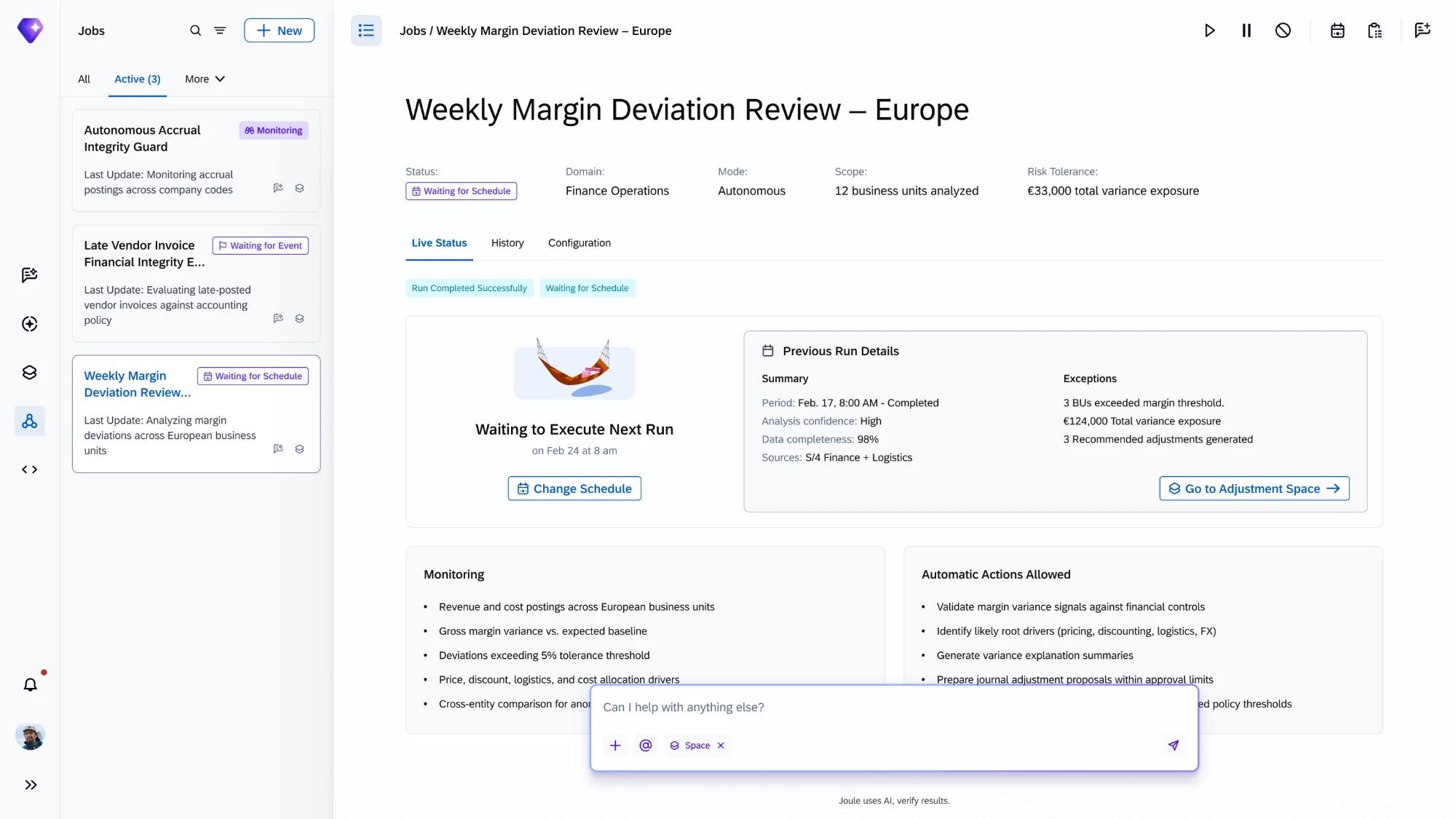
Agents work in technical steps. The people responsible for the outcome need to see that work in a consistent way, in terms that matter to their business. Every Job shows its live status the same way: what it is doing right now, what it observed, what it resolved on its own, what it monitors, and which actions it may take without asking.
04.4
Making exceptions actionable
When a run finds something, it explains each exception in business terms: the deviation, its driver and its status. From there, the person opens the investigation, or makes the decision the Job is waiting for.
04.5
Inspecting outcomes and history
Detail stays one level down, never gone. The run history lists every run of a Job: what triggered it, what it processed, what it found, what it did and how it ended. Runs waiting for a person stay marked until someone decides. Each run opens into its full timeline and audit trail, down to the policy that applied and the authority it ran under.
05
Design decisions
The design decisions that shaped Jobs
Jobs didn't start as an architecture. It came out of four decisions, each a choice between models that could all have worked. The fifth, how to pitch it, is told above under Making the case.
06
With customers
What customers told us
After each workshop we put the concept in front of customers. I initiated and directed the research; the researcher on my team ran it. In one study, finance and operations users from five companies walked through the Jobs screens one by one, then ran a SWOT on the concept.
What we learned
01
The contract is the right abstraction
The Job definition was the most praised part of the concept, at the right level of abstraction for business users. “Job” itself was readily understood.
02
Trust is earned over the first runs
People would inspect the first two or three runs in detail, then stop checking. They don't watch a running Job; they want to know when to come back.
03
Technical detail belongs one level down
The agents and capabilities section read as too technical, which confirmed supervising by outcome.
04
Accountability needs more than one name
Auditors ask who created a Job, who started a run and who changed what. Failures need recording as fully as successes.
05
A Job definition is knowledge to share
People wanted to copy definitions as templates and find what colleagues had built.
Where customers pushed back
01
Authorisation boundaries
In regulated finance, the fear is an agent posting with the wrong tax code. Governance, not usability, will decide adoption.
02
No safe way to try it
Participants asked for a dry run before the real one.
03
Too much configuration
People wanted sensible defaults, which supports setting autonomy at company and Job level.
07
Reflection
What I'd do differently
The first release of Jobs will focus on scheduled Jobs that business users create themselves. It's a pragmatic starting point, but I believe we underestimated an important enterprise requirement: companies want to control which agentic work is made available to their employees, under what conditions, and with which responsibilities.
Our customer engagements reinforced this. Business users aren't necessarily looking to build their own automations. They want to delegate meaningful work to trusted capabilities that their organization has already configured, approved, and provisioned. Their role shifts from creating automation to supervising outcomes, handling exceptions, and making decisions where human judgment is required.
Looking back, I would have connected the long-term Jobs concept to a more representative first release: predefined, governed Jobs provisioned by SAP or the enterprise, which business users can activate and supervise. This would have demonstrated the value of the execution contract from day one, while keeping the initial scope manageable.
The lesson for me is that defining the right long-term vision isn't enough. The first product slice must validate the core assumptions behind that vision, not simply deliver the easiest capability to implement.
- Strategic influence
One of five core Joule Work concepts
Leadership adopted Jobs as one of five core concepts of Joule Work, alongside chat, spaces, discover and skills.
- Concept validation
Tested with customers
A customer study after every sprint workshop. Customers understood the separation between delegating a business outcome and executing the work through agents: they rated the Job definition the right level of abstraction and found the agent detail too technical.
- Product realization
First release in development
The first release, scheduled Jobs, is in development, with the full execution-contract model as the direction beyond it. Not yet released; business impact remains to be measured.
What I learned
Enterprise AI is about governed delegation, not personal automation.
Customer engagements reinforced that businesses want to provision trusted agentic capabilities, while employees operate them, supervise outcomes, and intervene when needed. This has important implications for where the product should start.
A strong vision needs an equally strong first release.
We established Jobs as a core concept, but the initial implementation focuses on user-created scheduled work. In hindsight, I would have pushed harder for a first release that demonstrates enterprise-provisioned Jobs and their governance model.
Conceptual clarity is a leadership responsibility.
The breakthrough came when I stopped positioning Jobs as another way to execute work and established them as the accountable contract around agents, assistants, and workflows. Getting the model right changed the conversation with leadership.
Still open
How should enterprises provision agentic work at scale?
What should SAP deliver out of the box, what should organizations configure, and what freedom should individual users have?
How do we balance autonomy with accountability?
Who can authorize autonomous actions, and how do we ensure responsibility remains clear as work crosses agents, systems, and people?
How do we measure successful delegation?
Beyond execution success, how do we demonstrate reduced manual effort, better decisions, and improved business outcomes?